
Warehouse Rent in India: What Drives the Rs/sq ft and Typical Lease Terms
By Nihas MKH · Updated
In short
Warehouse rent in India is quoted per sq ft per month. In Q1 2026 average transacted rents ran from Rs 19.3 in Kolkata to Rs 28.5 in Pune, up 5% to 7% in every major market (Knight Frank). Micro-market, grade and unit size drive the rate. Expect a 3 to 6 month deposit, about 5% yearly escalation, 18% GST and a 3-year lock-in on Grade A.
Warehouse rent in India is quoted in rupees per square foot per month. In Q1 2026, average transacted rents across the eight major markets ranged from Rs 19.3 in Kolkata to Rs 28.5 in Pune, and rose 5% to 7% on a year earlier in every one of them (Knight Frank, Q1 2026). Three things move the rate most: the micro-market, the building's grade, and the unit size. Around the headline rent, budget for a security deposit of 3 to 6 months, CAM charges, 18% GST, and escalation of about 5% a year. Lock-ins of around 3 years are standard on Grade A leases.
This guide covers what rents are by city, what drives them, the terms that come with them, and the levers that actually move the number.
Warehouse Rent by City in 2026
Two views of the same market. The first column is Knight Frank's average transacted rent, across all grades, for Q1 2026. The second is the median asking rent for warehouse-scale units (20,000 sq ft and above) listed with WareOnGo in September 2026, which shows what owners are quoting right now.
| Market | Average transacted rent, Q1 2026 (Knight Frank) | Median asking rent, 20,000 sq ft+ (WareOnGo, Sep 2026) |
|---|---|---|
| Pune | Rs 28.5, up 6% | Rs 28.5 (18 listings) |
| Mumbai MMR | Rs 26.0, up 5% | Rs 22 in Bhiwandi (37 listings) |
| Bengaluru | Rs 25.6, up 5% | Rs 25 (218 listings) |
| Chennai | Rs 25.6, up 7% | Rs 25 (24 listings) |
| Ahmedabad | about Rs 24.8 | Rs 17 (30 listings) |
| Delhi NCR | Rs 22.3, up 5% | Rs 21 in Gurugram (99 listings) |
| Hyderabad | Rs 21.9, up 5% | Rs 20 (79 listings) |
| Kolkata | Rs 19.3, up 5% | Rs 23.5 (37 listings) |
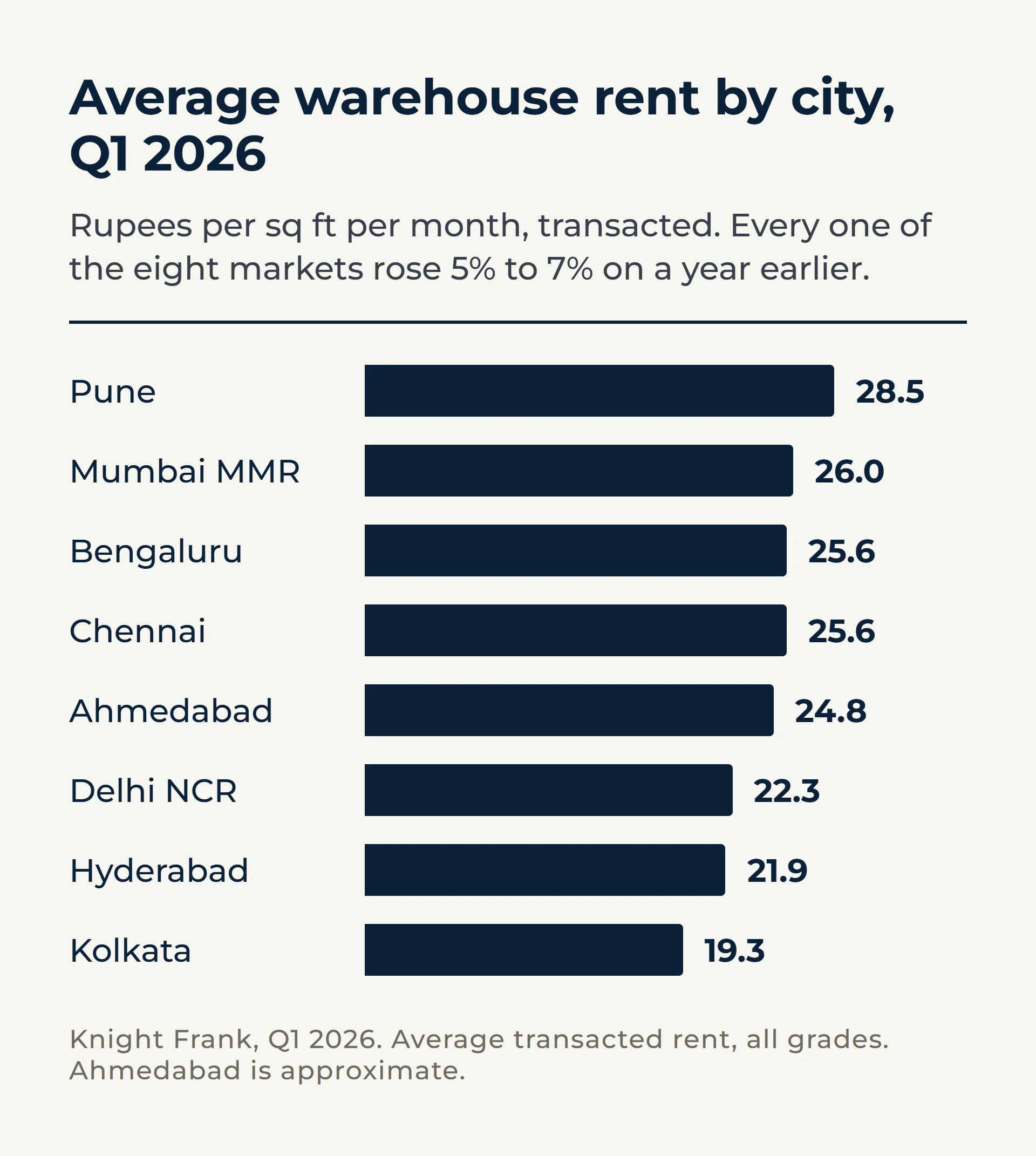
All figures are rupees per sq ft per month. In most cities the two views sit within a rupee or two of each other, which tells you that at warehouse scale, asking rents are close to where deals close. Where they diverge, as in Ahmedabad and Kolkata, the difference usually comes from which corridors and grades each sample happens to cover.
The spread inside a city routinely exceeds the spread between cities. In Bengaluru, median asking rents run from Rs 22 on Tumkur Road to Rs 40 near the airport. Our Bangalore warehousing market analysis breaks that down belt by belt.
What Determines the Rate per sq ft
- Micro-market, not city. Proximity to highways, ring roads, the consumption centre and labour decides the rate. A site with container access and a city run of under an hour prices at a premium.
- Grade and specification. Clear height, floor flatness and load rating, dock levellers and fire systems all add rent. Grade A commands a premium over Grade B in the same corridor; our Grade A vs B vs C guide sets out what you get for it.
- Unit size. Small units cost far more per sq ft. In Bengaluru, the median asking rent for units under 5,000 sq ft is Rs 62.5, against Rs 25 for 20,000 to 50,000 sq ft. Below a certain size you are paying shop and commercial rates, not warehouse rates.
- Compliance completeness. A fully papered warehouse, with a fire NOC, an occupancy certificate and converted land, commands more, and is worth more, because a gap in any of them shifts the risk onto you.
- Supply pipeline. Corridors with heavy new Grade A construction see soft rents. Land-locked urban godown clusters see steady rises.
- Lease tenure and tenant strength. A 9-year lease from a strong corporate tenant gets a better rate than a 2-year lease from an unknown one.
How the Rent Is Quoted
The quoted rate is almost always per sq ft per month, on whatever area the lease defines as chargeable. It usually excludes GST, and often excludes CAM, power and water. Two things follow.
First, ask which area the rate applies to: carpet, built-up or super built-up. The same rate on a different area can change the real cost by 10% to 15%. Our guide to carpet area vs built-up area explains the difference.
Second, never compare two quotes on the headline rate. Escalation, CAM, rent-free months and the deposit can reverse the ranking. Our guide on how to compare warehouse rent quotes works through a full five-year example.
Standard Commercial Terms in Indian Warehouse Leases
| Term | Typical range | Notes |
|---|---|---|
| Security deposit | 3 to 6 months' rent | Refundable and interest-free; strong tenants can negotiate it down |
| Lock-in | About 3 years on Grade A; 1 to 2 years on Grade B and C | Exiting during the lock-in usually means paying the remaining lock-in rent |
| Tenure | 3 to 9 years, often 3+3+3 | Leases over a year must be stamped and registered |
| Escalation | About 5% a year, or 15% every 3 years | It compounds, so model the full term |
| Rent-free fit-out period | 15 to 60 days | Tied to fit-out scope; ask for it explicitly |
| Notice period | 3 to 6 months after the lock-in | Push for the same notice period on both sides |
| CAM | A few rupees per sq ft in organised parks | Get the inclusion list in writing |
| Property tax and structural repairs | Conventionally the landlord's | Some leases pass them through; check the clause |
Built-to-suit leases run longer: about 10 years with a 5 to 6 year lock-in, because the developer has built for one tenant. Our built-to-suit warehouse guide covers when that trade is worth it.
Taxes on Warehouse Rent
- GST at 18%. Renting commercial or warehousing space attracts GST at 18%. A registered tenant can usually claim it as input tax credit, but it still affects cash flow each month.
- Reverse charge when the landlord is unregistered. Since October 2024, a GST-registered tenant renting from an unregistered landlord pays the GST itself under reverse charge. Check your landlord's GST status before signing.
- TDS on rent. Tenants who deduct tax at source withhold 10% on rent for land and buildings once rent crosses Rs 50,000 a month.
Negotiation Levers That Actually Work
- Build competition. Three to five comparable options in the same micro-market are your biggest source of leverage. Landlords price against the visible alternative.
- Trade tenure for rent. A longer lock-in is worth a lower starting rent, or a longer rent-free period, to most landlords.
- Time the market. In corridors where new parks are leasing up, developers discount to land their first tenants.
- Negotiate escalation and deposit, not only rent. Over a 9-year term, yearly 5% escalation costs about 6% more in total rent than 15% every three years on the same starting rate.
- Look at under-construction stock. Committing before completion routinely prices below ready stock.
How Rents Are Moving
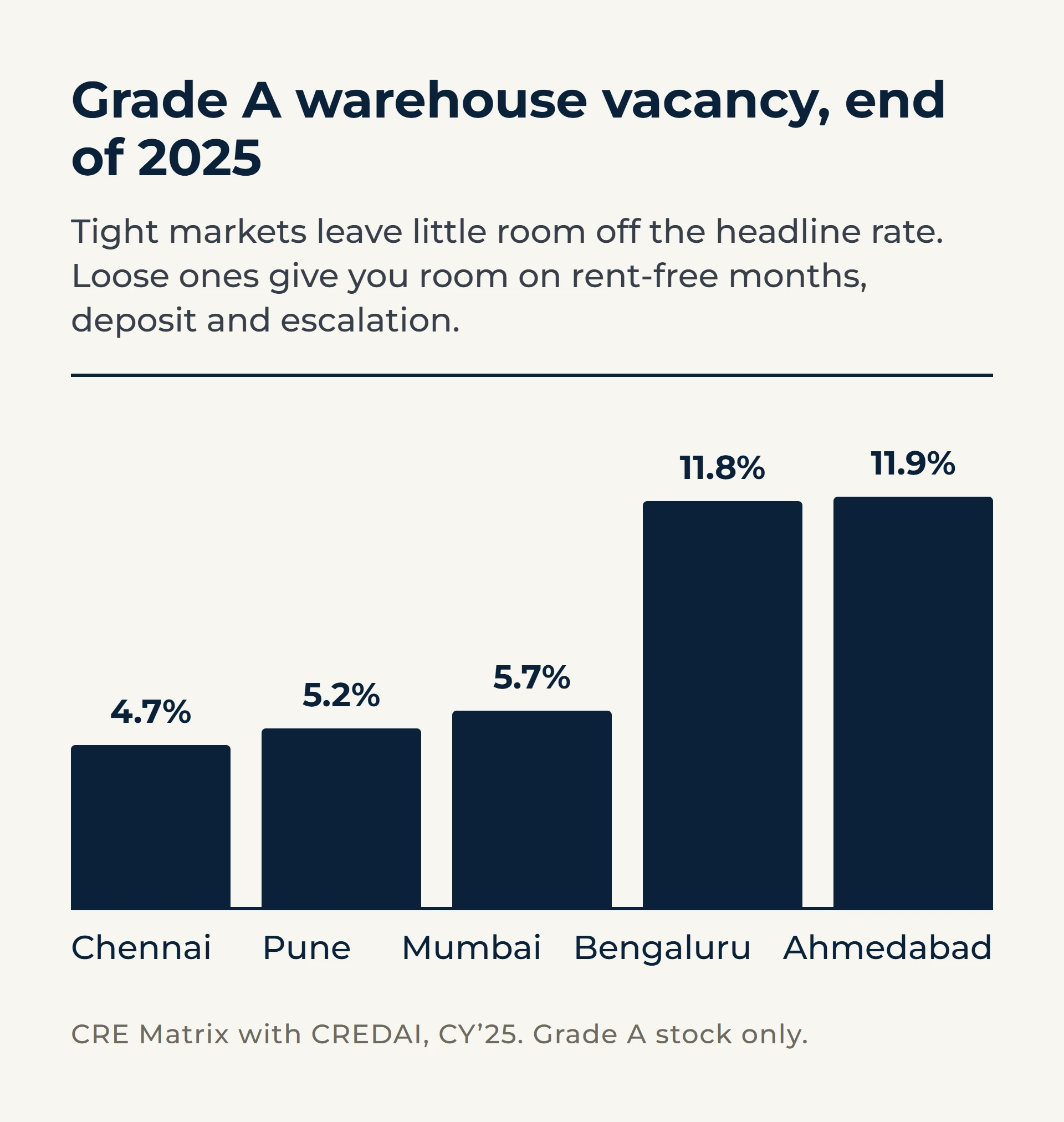
Rents rose in all eight major markets in 2025 and again in Q1 2026, by 5% to 7% year on year (Knight Frank). Grade A vacancy is where the leverage sits. It was tightest at the end of 2025 in Chennai (4.7%), Pune (5.2%) and Mumbai (5.7%), and loosest in Ahmedabad (11.9%) and Bengaluru (11.8%) (CRE Matrix with CREDAI, CY'25). In a tight market, move fast and expect little off the headline rate. In a loose one, you have room to push on rent-free months, deposit and escalation.
Clients transacting through WareOnGo typically save 8% to 12% on commercials. Most of that comes from micro-market comparables and negotiating the full term sheet, not only the headline rent.
Frequently Asked Questions
In rupees per square foot per month, on the area the lease defines as chargeable, which may be carpet, built-up or super built-up. GST at 18% is extra, and CAM, power and water are often billed separately.
In Q1 2026, average transacted rents across the eight major markets ranged from Rs 19.3 per sq ft per month in Kolkata to Rs 28.5 in Pune, with Bengaluru and Chennai at Rs 25.6 (Knight Frank). Rates inside a city vary more than rates between cities.
Three to six months' rent, refundable and interest-free. Strong tenants can negotiate it down, and heavy power or custom fit-out requirements can push it up.
The period during which neither side can end the lease without paying the rent for the remaining lock-in. It is usually about 3 years on Grade A warehouses and 1 to 2 years on Grade B and C.
Yes, at 18%. A GST-registered tenant can usually claim it back as input tax credit. If the landlord is not GST-registered, a registered tenant pays the GST itself under reverse charge.
Common area maintenance charges cover shared security, housekeeping, landscaping and upkeep in a park. They are usually a few rupees per sq ft per month on top of rent, so get the inclusion list and the rate in writing.
Because micro-market, grade and unit size all change the rate, and a city contains all of them. A small RCC unit inside the city and a large PEB shed on a highway are different products, priced off different land values. For live availability and asking rents in a specific city, WareOnGo's city listing pages carry physically verified inventory. Or write to sales@wareongo.com with your requirement.
Related Blogs
Looking for warehouse space?
Browse verified, physically inspected warehouses across India, or tell us your requirement and get a curated shortlist within 4 hours.