
Built-to-Suit (BTS) Warehouses in India: When They Make Sense
By Nihas MKH · Updated
In short
A built-to-suit (BTS) warehouse is built by a developer to one tenant's specification on a long pre-committed lease, typically about 10 years with a 5 to 6 year lock-in. End to end it takes roughly 12 to 20 months. It suits large occupiers with a planned ramp-up and a spec no ready building meets without costly rework.
A built-to-suit (BTS) warehouse is constructed by a developer to a tenant's exact specification, on a site the tenant has effectively pre-committed to lease. You get the layout, height, dock count and expansion room you actually need, instead of adjusting your operation to fit whatever is standing empty. The tradeoff is time and commitment: BTS takes considerably longer than moving into ready stock, and it is a route developers open to large occupiers taking large boxes on long leases, because only that combination justifies building for one tenant. A BTS warehouse is for you when your requirement is big, your ramp-up is planned well in advance, and no existing building on the market fits your operation without expensive rework. It does not make sense when you need space now, or when your volumes are still uncertain enough that you would rather not sign a long lease.
What Is a Built-to-Suit Warehouse?
In a built-to-suit deal, a developer builds a warehouse for one tenant, on land the developer owns or is acquiring for that purpose. The tenant hands over a requirement (clear height, dock leveller count, floor loading, office and mezzanine area, power sanction, fire-system needs) and the developer designs and constructs against that brief, then leases it long-term.
This is different from a ready-to-move (RTM) warehouse, where the building exists and you evaluate it as-is, and different from pre-leasing in a speculative Grade A park, where the developer builds a standard shed and you commit before completion but do not get to change the design. BTS is the only route where the building is shaped around your operation rather than the other way round.
How the BTS Process Actually Works
A built-to-suit deal moves through a fairly consistent sequence, even though the pace varies by developer and city.
- Requirement definition. Storage volume, throughput, racking plan, dock and yard needs, and future expansion, scoped with your operations team so the brief reflects real usage rather than a rough guess.
- Site shortlisting. The developer proposes parcels, or you bring a location and the developer tests feasibility, connectivity and approvals. Large occupiers run this as a formal request for information, with every candidate parcel answering the same question set.
- Design and costing. Layout, structure and specifications get finalised, and the lease commercials are negotiated alongside them, because the building cost feeds directly into the rent the developer needs to charge.
- Agreement to lease or letter of intent. A binding commitment signed before construction starts. Point of no return for both sides: you are locked into a long lease, the developer is committing capital to a single-tenant build.
- Construction, with tenant inspection rights at agreed milestones.
- Handover and fit-out. Racking, material-handling equipment, IT and security, often overlapping the tail of construction.
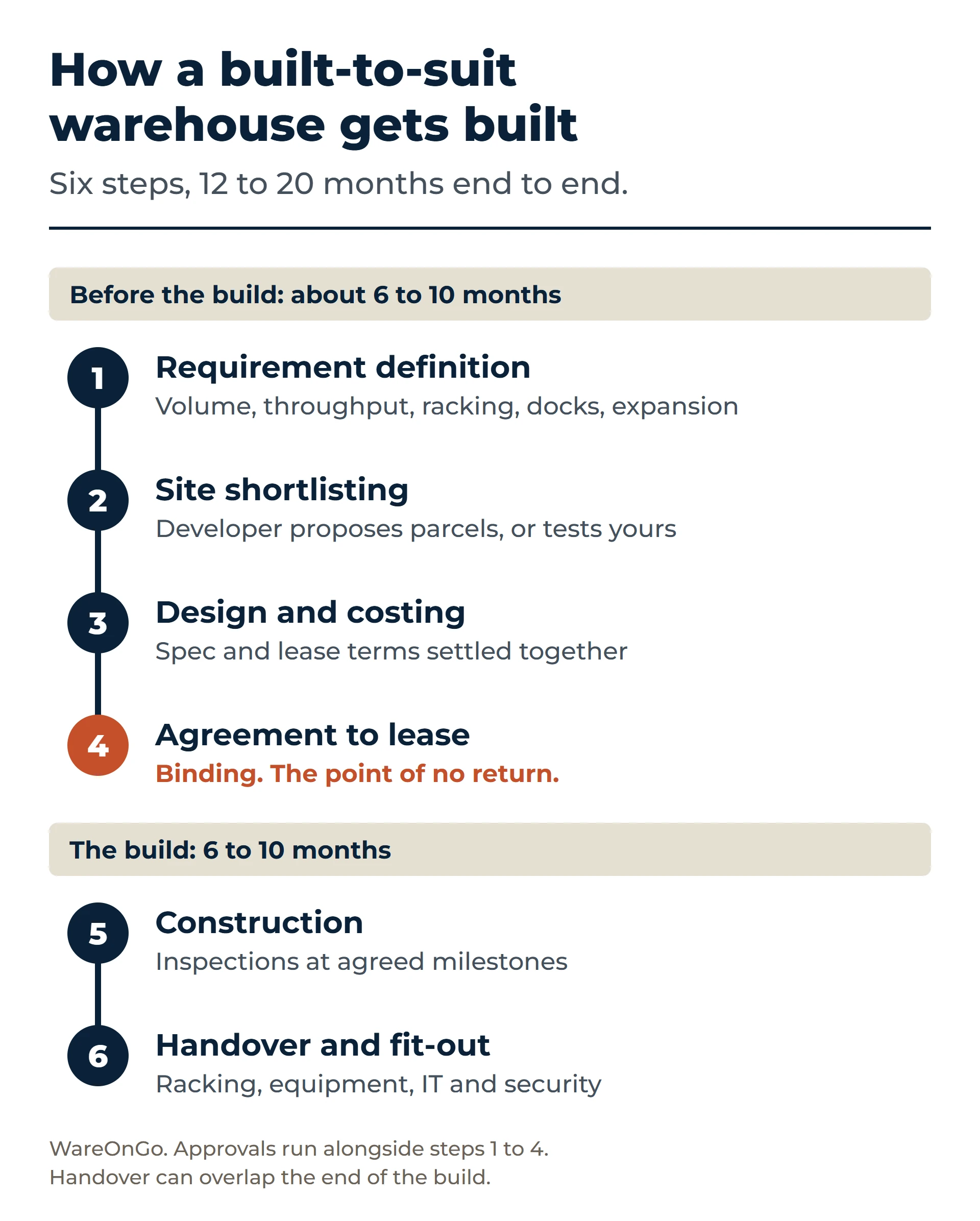
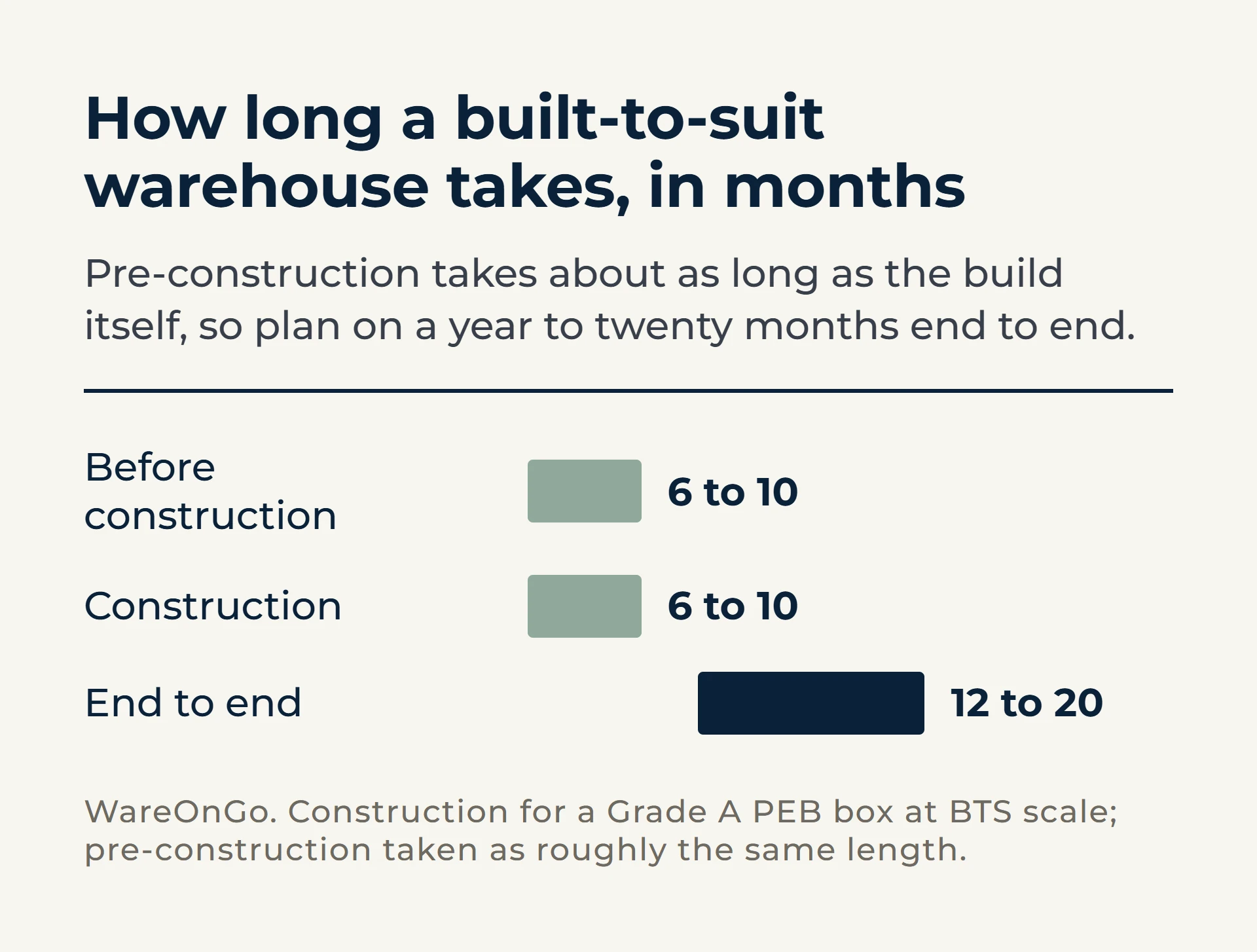
Steps 1 to 4 routinely take as long as the construction itself. That is the part tenants underestimate, because it is invisible: nothing is being built yet.
Construction of a Grade A PEB box at BTS scale runs 6 to 10 months, from signed agreement to lease to handover, with 8 months a fair average and the 6-month end reserved for an accelerated programme. Set that against a pre-construction phase of roughly the same length and the end-to-end range is about 12 to 20 months, or a little over a year and a half on an average build.
The Approvals Are the Real Timeline, Not the Steel
On a ready-to-move warehouse the building already stands, which means its land-use conversion, sanctioned plan and occupancy certificate either exist or they do not, and you find out during diligence. On a built-to-suit, those approvals sit on your critical path.
The land has to be converted or zoned for industrial or warehousing use, called CLU (change of land use) or NA (non-agricultural conversion) depending on the state. Signing before land-use conversion is verified is the single most common deal-breaker in Indian warehouse leasing, and on a BTS the conversion may still be in progress when you sign the agreement to lease. Budget 3 to 6 months for it, and understand that it can run longer. The route and the pace differ by state: NA conversion runs through the Collector in Maharashtra and is often the slowest step near Mumbai, DC conversion under the Land Revenue Act in Karnataka, CLU permission from the Town and Country Planning department in Haryana, and the local planning authority or DTCP in Tamil Nadu. A parcel already sitting in the right zone moves faster; the wrong parcel is open-ended.
Fire NOC follows the building, not the land, so it cannot be applied for until the design is fixed. Where the site infrastructure is already in place, expect 1 to 2 months. If your goods need pollution-board clearance, Consent to Establish has to come before you set up and Consent to Operate before you begin activity, which is two approvals in sequence rather than one.
That is the real answer to why BTS takes as long as it does. The steel goes up quickly. The paperwork in front of it does not.
None of this is a reason to avoid BTS. It is a reason to ask the developer which approvals are already in hand on the parcel, in writing, before the agreement to lease is signed. Our warehouse compliance checklist covers the full document set and who is responsible for each part of it.
BTS vs Ready-to-Move: What Actually Changes
| Factor | Built-to-suit (BTS) | Ready-to-move (RTM) |
|---|---|---|
| Design fit | Built to your exact spec | You adapt to what exists |
| Time to occupy | Design, approvals and construction, in sequence | As soon as diligence and fit-out are done |
| Lease commitment | Around 10 years, with a 5 to 6 year lock-in | Shorter terms and lock-ins are easier to find |
| Who it is for | Large occupiers taking large boxes | Works at almost any size |
| Site choice | You can target the exact micro-market and land parcel | Limited to whatever is currently listed nearby |
| Expansion planning | Built in from day one if you plan for it upfront | Retrofitting expansion later is harder and costlier |
| Approvals risk | Land-use conversion and fire NOC may still be open when you commit | Already resolved or already disqualifying, and visible in diligence |
| Your exposure if timelines slip | You have signed a lease for a building that does not exist yet | You are evaluating a building you can walk through |
When BTS Makes Sense
Your requirement is genuinely large. Developers take on construction and land risk because a big box on a long lease makes it worthwhile. The common thread among BTS tenants is not sector but certainty: manufacturers setting up a plant with an attached warehouse, 3PLs anchoring a regional hub for one big client, e-commerce and FMCG companies opening a fulfilment centre for a city launch. Each arrives with a known volume, a known timeline, and a spec unusual enough that adapting an existing shed would cost more than starting fresh.
You have real lead time. If your ramp-up or market entry is planned a year or more out, BTS timelines stop being a constraint and start being an advantage.
Nothing on the market fits without expensive rework. Unusual floor loading for heavy racking, a dock ratio and apron depth sized for 42 to 46 ft trailers, a site tied to a supplier or customer cluster. If retrofitting an existing shed would cost nearly as much as building fresh, BTS is the cheaper option, not the slower one.
You want to lock in a location before it disappears. In fast-filling corridors the micro-market you want may have no ready stock left. BTS secures the location itself, with the building following on your terms.
Your operation benefits from built-in expansion. As covered in our PEB vs RCC warehouse guide, steel-framed sheds can take bays added lengthwise later, which is why build-to-suit campuses in India are almost always PEB rather than RCC.
When BTS Does Not Make Sense
You need space in the next few months. Design, approvals and construction take real time. If you are solving an immediate capacity problem, ready-to-move space is the only realistic route.
Your volumes are still uncertain. A BTS lease runs around 10 years with a 5 to 6 year lock-in, because the developer needs the term to justify the build. If you are not confident about your throughput two or three years out, that commitment works against you.
You need flexibility to exit or downsize. A custom building tied to a single tenant is harder for a developer to re-let if you leave early, which is exactly why BTS leases are structured to discourage early exit.
What BTS Actually Costs, and Why the Quote Can Go Either Way
BTS rent is not a market rate. It is derived: land cost, plus construction cost, plus the developer's required return over the lock-in period. Which means the quote moves in whichever direction your specification pushes it.
A standard spec can price below market. If you want a conventional Grade A PEB box with industry-standard specifications, the developer is getting something valuable in exchange: a creditworthy tenant on a long lease, committed before a brick is laid, with no marketing period and no vacancy risk. That certainty is worth a discount, and a generic BTS requirement will often be quoted below the prevailing rate for comparable ready space.
A demanding spec pushes something up. If the brief is genuinely custom, a high clear height with heavy floor loading, a dense dock ratio, a deep truck apron, a large power sanction, or an RCC structure rather than PEB, the developer's cost per sq ft rises and the building becomes harder to re-let to anyone else. The developer recovers that in one of three places, or in a combination: a higher rent, a longer term or lock-in, or a higher security deposit. A heavy power requirement, for instance, is commonly absorbed by raising the deposit from the usual six months to eight rather than by touching the rent at all.
Compare like with like. BTS quotes often come as a flat rent held for the full term, while market rents are quoted as a year-one figure that escalates. Those are not comparable numbers, and the gap is bigger than most people assume.
Take a year-one rent of Rs 21 per sq ft per month escalating at 5% a year, which is the common structure. By year ten it is Rs 32.6, and the average across the full ten-year term is Rs 26.4. So a flat BTS quote of about Rs 26 and an escalating market quote starting at Rs 21 are, in cash terms, close to the same deal. A flat quote that looks 25% expensive on day one is usually just the same rent expressed differently.
And the right benchmark is not today's asking rent at all. It is ready-to-move rent plus the capex of retrofitting that building to your spec, amortised over the same term.
Questions to Work through before You Commit
- Is our volume forecast solid enough to justify a 5 to 6 year lock-in, or are we still guessing?
- Have we actually priced out retrofitting an existing warehouse, or are we assuming BTS is necessary without checking?
- Which approvals on this parcel are already in hand, and which are still open on the developer's side?
- Which line items in our specification are genuinely operational requirements, and which are preferences we are paying a premium to keep?
- What happens to our timeline if the developer misses a construction milestone, and is that risk written into the agreement to lease?
- Does the design leave room for the expansion we expect to need, or are we building exactly to today's volume?
Planning a build-to-suit requirement in Bengaluru, NCR, Pune or Hyderabad? Tell us your requirement and we will come back with a shortlist of both ready-to-move options and developers who take on BTS at your scale, within 4 hours.
Frequently Asked Questions
A built-to-suit (BTS) warehouse is a facility a developer constructs to a specific tenant's requirements, under a pre-agreed long-term lease, rather than an existing building the tenant simply moves into. The tenant sets the specification; the developer carries the construction.
BTS is a large-occupier route. Developers take on land and construction risk for one tenant only when the box is big and the lease is long, which in practice means large corporates and large 3PLs rather than mid-market operations. If your requirement is modest, existing Grade A or Grade B stock gives you better terms and far faster occupancy.
Construction of a Grade A PEB box at BTS scale runs 6 to 10 months, averaging about 8. Requirement definition, site finalisation and commercial negotiation typically take as long as construction itself, and the approvals run alongside them, which puts the end-to-end range at roughly 12 to 20 months. Land-use conversion should be budgeted at 3 to 6 months and can take longer, while a fire NOC takes 1 to 2 months once the site infrastructure is in place. Anyone who needs space inside a few months is looking at ready-to-move stock, not BTS.
It depends on how custom the brief is. A conventional Grade A PEB box on a long lease can be quoted below market, because the developer is trading a rent discount for a committed tenant and zero vacancy risk. A specialised building costs more to build and is harder to re-let, so the developer recovers it through higher rent, a longer lock-in, a larger deposit, or a mix of the three.
BTS agreements typically run about 10 years with a 5 to 6 year lock-in, longer than a standard warehouse lease, because the developer has built a facility around one tenant and cannot easily re-let it as-is. Exit terms, and what happens if the developer misses a construction milestone, should be negotiated explicitly in the agreement to lease rather than assumed.
Related Blogs
Looking for warehouse space?
Browse verified, physically inspected warehouses across India, or tell us your requirement and get a curated shortlist within 4 hours.