
Warehouse Compliance Checklist for India: Licences, NOCs & Lease Paperwork
By Nihas MKH · Updated
In short
Leasing a warehouse in India needs three layers of paperwork: the landlord's title, land-use conversion, building approvals and fire NOC; the tenant's GST, trade, shops and sector licences such as FSSAI; and a stamped, registered lease if the term exceeds a year. Land-use conversion is the most common deal-breaker.
Leasing a warehouse in India needs three layers of paperwork. First, the landlord's documents: clean title, industrial land use, an approved building plan, an occupancy certificate and a valid fire NOC. Second, your own registrations: GST for the location, a trade licence, shops and establishments registration, and any sector licence, such as FSSAI for food, a drug licence for pharma or pollution-board consent for chemicals. Third, the lease itself: a lease for more than a year must be stamped and registered. Miss one and you risk stalled operations, a rejected insurance claim or blocked tax credit.
This guide is general information, not legal advice. Rules, thresholds and fees vary by state and change over time. Confirm current requirements with the relevant authority or your counsel before acting.
Compliance is where Indian warehouse deals slip their timelines. The shed may be ready, but if the fire NOC is pending, or the land was never converted from agricultural use, you cannot legally stock goods there, and your insurer can reject a claim even if you do. This checklist covers the documents only. For the physical side, the road, docks, floor, roof and fire equipment, use our warehouse inspection checklist.
We have seen the cost of skipping this first-hand. One client leased a shed in Bhiwandi without confirming its fire NOC. When the building burned down, the insurer rejected the claim outright because the NOC was missing. We then rehoused them in a fully compliant, physically verified facility. One missing document turned a routine fire into a total, uninsured loss.
Layer 1: The Landlord's Documents to Verify before Signing
- Title documents and encumbrance certificate. Confirm the landlord owns the property, or has the right to lease it, with no hidden mortgage that could disrupt your tenancy.
- Land-use status. The land must be converted or zoned for industrial or warehousing use, called CLU (change of land use) or NA (non-agricultural conversion) depending on the state. A warehouse on unconverted farm land is the most common serious red flag in Indian warehousing.
- Sanctioned building plan and occupancy or completion certificate. The building you lease should match the approved plan, including any mezzanine or extension.
- Fire NOC from the state fire department. Required above state-specific height and area thresholds, set under the National Building Code of India 2016, Part 4 (Fire and Life Safety), and each state's Fire Service Act. Check that it covers the actual building and is still valid, since NOCs need periodic renewal.
- Property tax receipts and utility connections. Unpaid dues surface later as disconnection notices.
- Structural stability certificate for older buildings. Some municipal licences ask for it.
- For land in a government industrial estate: check the allotment permits warehousing, and get the development authority's written permission if the space is being sublet to you.
Layer 2: Registrations You Need as the Tenant
- GST. Add the warehouse as an "additional place of business" on your GST registration in that state. If you have no registration in the state, you need a new GSTIN there. Without it, stocking goods there is non-compliant, because your e-way bills (the electronic documents for moving goods) will not match your registration.
- Trade licence from the local municipal body or panchayat, where it applies to storage or commercial activity.
- Shops and establishments registration for the premises if you employ staff there. Rules are state-specific.
- Labour registrations as headcount grows. Provident fund, ESI and contract-labour rules now sit under India's four labour codes, which came into force on 21 November 2025, replacing the older separate Acts. Check the current thresholds for your headcount and for contract workers under the codes.
- Legal metrology registration under the Legal Metrology Act, 2009, if you repack goods or declare weights and measures at the facility.
Sector-Specific Licences
| If you store... | You need... |
|---|---|
| Food, beverages, nutraceuticals | FSSAI licence for the storage premises (state or central, depending on turnover) |
| Pharmaceuticals | Drug licence for wholesale or storage from the state drug authority; temperature mapping for cold chain |
| Chemicals, batteries, anything hazardous | State Pollution Control Board consent (CTE and CTO, below); PESO licence for petroleum and explosives classes |
| Insecticides and pesticides | Licence under the Insecticides Act from the state agriculture department |
| Imported goods under bond | Customs bonded warehouse licence under Sections 57 and 58 of the Customs Act, 1962 |
| Agri commodities for negotiable receipts | WDRA registration under the Warehousing (Development and Regulation) Act, 2007 |
Pollution-board consent comes in two steps. For chemicals and hazardous goods you usually need Consent to Establish (CTE) before you set up and Consent to Operate (CTO) before you begin activity, under the Water Act, 1974 and the Air Act, 1981. Tenants often apply for one and stall at inspection.
Layer 3: Lease Formalities
- Stamp duty. Payable on the lease deed at state-specific rates. An under-stamped deed cannot be used as evidence until it is rectified and a penalty paid.
- Registration. Under Section 17(1)(d) of the Registration Act, 1908, read with Section 107 of the Transfer of Property Act, 1882, a lease from year to year, or for any term exceeding one year, must be registered with the sub-registrar. That is why short leases are commonly drafted at 11 months. Always register a warehouse lease of 3 to 9 years: in a dispute, an unregistered long lease for a warehouse can be treated as a month-to-month tenancy, and your multi-year protection disappears.
- Fit-out and reinstatement clauses. Agree upfront who owns the racking, dock equipment and electrical upgrades when you exit, and what you must restore.
- Insurance split. The landlord typically insures the structure; you insure stock, fit-outs and liability. Check that the fire systems meet your insurer's requirements, because an NOC alone may not.
- Commercial terms. Deposit, lock-in, escalation and CAM belong in the same deed. Our warehouse rent guide covers the standard ranges, GST and TDS on rent.
A Realistic Sequencing Plan
- Check the landlord's papers, allowing 1 to 2 weeks. Run the title and land-use checks alongside the commercial negotiation, not after it.
- Sign, stamp and register the lease. Take possession.
- File the GST additional-place-of-business amendment the same week. Approval is usually quick, and stocking before approval creates e-way bill problems.
- Apply for sector licences (FSSAI, drug, pollution board) as soon as the registered lease exists. Most applications need the lease deed as proof of premises.
- Put fire NOC and licence renewal dates in a compliance calendar. A lapse can void your insurance.
Indicative Licence Timelines and Issuing Authorities
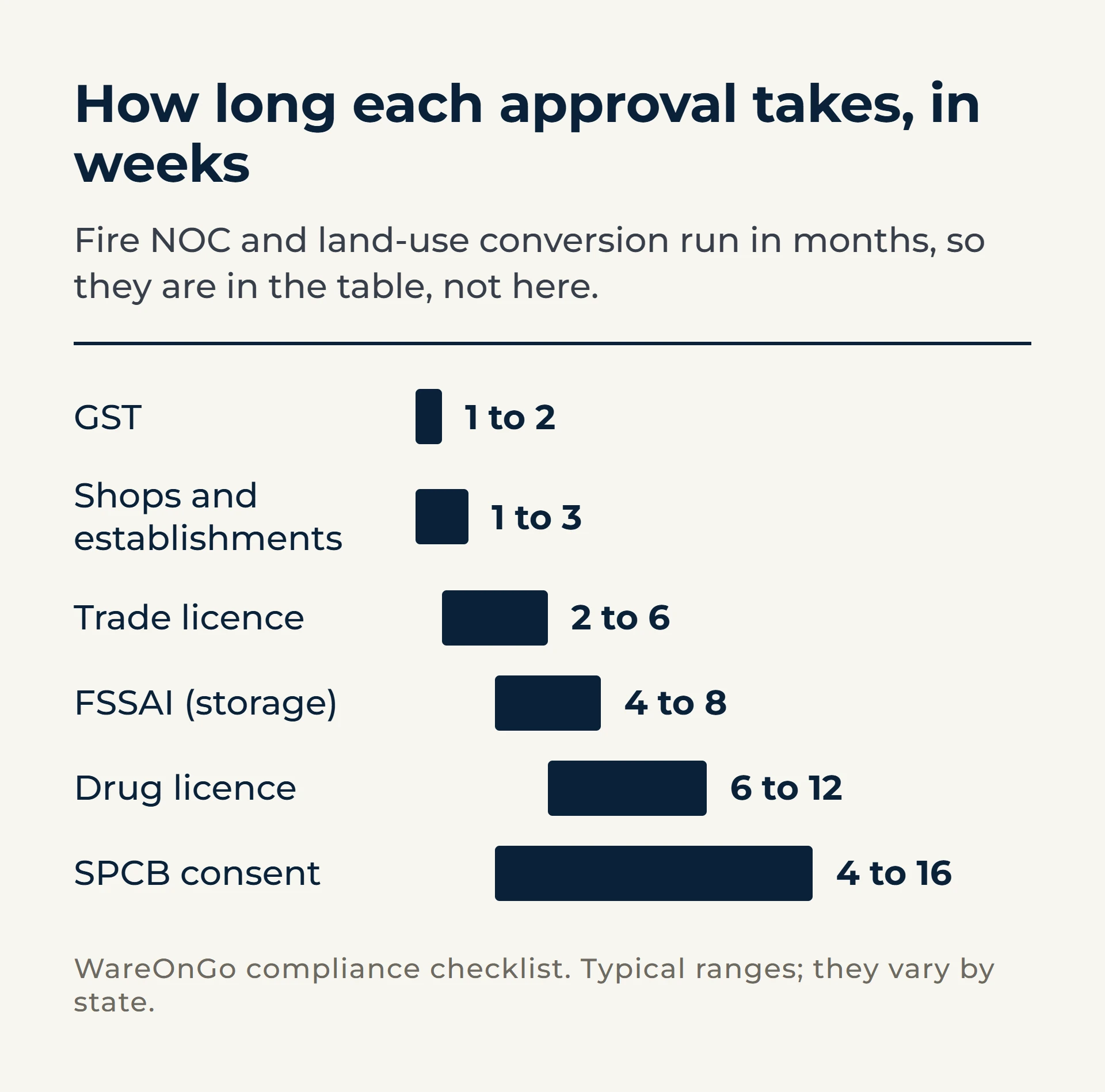
Timelines vary by state and by how complete your application is. Treat these as planning ranges, not commitments.
| Registration or licence | Issuing authority | Indicative timeline |
|---|---|---|
| GST additional place of business | GST portal (state jurisdiction) | 1 to 2 weeks |
| Fire NOC (new) | State fire department | 1 to 2 months where site infrastructure is already in place; up to 3 months otherwise |
| FSSAI licence (storage) | FSSAI (state or central, by turnover) | 4 to 8 weeks |
| Trade licence | Municipal corporation or panchayat | 2 to 6 weeks |
| Shops and establishments registration | State labour department | 1 to 3 weeks |
| SPCB consent to operate | State pollution control board | 4 to 16 weeks |
| Drug licence (wholesale or storage) | State drug control authority | 6 to 12 weeks |
| Lease registration | Sub-registrar office | Same day to 1 week after stamping |
| Land-use conversion (for a new build) | Revenue or planning authority, by state | 3 to 6 months, and it can run longer |
How Compliance Differs by State
"State-specific" appears throughout this checklist for a reason. A few examples of the same requirement playing out differently:
| State | Land-use conversion | Stamp duty on a lease (indicative) |
|---|---|---|
| Maharashtra | NA conversion through the Collector; often the slowest step near Mumbai | Calculated on average annual rent plus deposit, slab-based |
| Karnataka | Conversion under Section 95 of the Land Revenue Act; since September 2025, land already zoned for the use in an approved master plan is certified by the planning authority rather than the Deputy Commissioner | Charged on average annual rent, with a cap for longer terms |
| Haryana (NCR) | CLU permission from the Town and Country Planning department | Percentage of average annual rent, linked to tenure |
| Tamil Nadu | Conversion through the local planning authority or DTCP | Slab-based on rent and tenure |
In Karnataka, industrial land allotted by KIADB comes with stricter terms than many tenants assume: the allotment is for industrial use, warehousing must be permitted under it, and subletting needs KIADB's written NOC. Always confirm the current process and rate with the state authority or your counsel, because both are revised periodically.
Common Compliance Mistakes
- Signing before verifying land-use conversion. The single most common deal-breaker, and it undermines every licence that follows.
- Stocking goods before the GST amendment is approved. The e-way bill mismatches surface at audit.
- Treating an expired fire NOC as a formality. As the Bhiwandi case shows, insurers treat it as a coverage gap.
- Leaving the lease unregistered to save stamp duty. In a dispute, your multi-year lease can be treated as month-to-month.
- Assuming the landlord's compliances cover your operations. They do not. The two layers are separate.
- Forgetting renewal calendars. Fire NOCs, FSSAI licences and pollution consents all lapse, and lapses are usually discovered during a claim or an inspection, the worst possible time.
Every warehouse listed on WareOnGo is physically verified, with its compliance documentation checked, before it goes live. Across 2,000+ verified warehouses in 90+ cities, our median time from a client sending a requirement to receiving a matched, compliance-checked shortlist is about 4 hours. We then coordinate the paperwork from diligence to possession.
Glossary
- NOC: No Objection Certificate, here from the fire department.
- CLU / NA: change of land use and non-agricultural conversion, the approvals that make land legally usable for industry or warehousing.
- CTE / CTO: Consent to Establish and Consent to Operate, the two pollution-board approvals for regulated goods.
- WDRA: Warehousing Development and Regulatory Authority, which registers warehouses that issue negotiable warehouse receipts.
- PESO: Petroleum and Explosives Safety Organisation, which licenses petroleum and explosives storage.
Frequently Asked Questions
Yes, for warehouses above state-specific height and area thresholds set under the National Building Code 2016 and each state's Fire Service Act. It comes from the state fire department and needs periodic renewal. Operating without one risks sealing, prosecution and rejected insurance claims.
If you have no GST registration in that state, yes, you need a GSTIN there. If you already have one, you add the warehouse as an additional place of business. Either way, the warehouse must be on your registration before you stock goods.
Yes, if it runs for more than a year or from year to year, under Section 17(1)(d) of the Registration Act, 1908, after paying state stamp duty. That is why short leases are drafted at 11 months. An unregistered long lease can be treated as month-to-month in a dispute.
Land-use conversion. A surprising share of otherwise good sheds sit on land never converted from agricultural use, which puts every downstream licence at risk. Verify the CLU or NA status before you spend time negotiating.
Both, for different layers. The landlord must hold title, building approvals, land-use conversion and the fire NOC. The tenant must obtain GST, trade and sector licences for its own operations. A well-drafted lease records each side's obligations.
Around 1 to 2 months for a new NOC where the site infrastructure is already in place, and up to about 3 months otherwise, depending on the state and inspection scheduling. Renewals are faster. Leasing a warehouse that already holds a current NOC takes it off your critical path.
It is legally risky and usually a false economy. The GST amendment must come before stocking. Storing food before FSSAI, or regulated goods before pollution-board consent, exposes you to penalties and seizure. File everything the day the registered lease exists, and use the fit-out window as licence lead time.
Related Blogs
Looking for warehouse space?
Browse verified, physically inspected warehouses across India, or tell us your requirement and get a curated shortlist within 4 hours.